Abundant images do not imply abundant 3D labels.
Pre-training can cover common visual conditions at scale, yet high-quality camera, depth, point-map, and human geometry supervision remains costly to acquire.
1Peking University 2Tsinghua University 3Huazhong University of Science and Technology
Long-tail domain shifts break cross-view correspondences in feed-forward 3D reconstruction, a failure that channel-wise PEFT does not directly address. 3R-Adapter freezes the backbone and restores relations through Deformable Retrieval, Relational Rewiring, and Consistency Refinement. This relation-centric design improves low-light reconstruction, test-time adaptation, and joint human-scene reconstruction with lightweight trainable modules.
Two-minute overview
An overview of the motivation, three-stage method, and reconstruction results.
Motivation
Feed-forward reconstruction models learn geometry from large-scale pre-training, but dense 3D ground truth is expensive. The remaining data are not merely fewer samples. They occupy difficult, shifted regimes where the model's learned relational routes no longer hold.
Pre-training can cover common visual conditions at scale, yet high-quality camera, depth, point-map, and human geometry supervision remains costly to acquire.
Low light suppresses texture, dynamic humans break static-scene assumptions, and test-time adaptation offers only a few unlabeled views from one scene.
Under shift, attention becomes diffuse and fragmented. Features may remain plausible locally while cross-view correspondence becomes unreliable.
Observation to insight
Conventional adapters and low-rank reparameterization adjust features and leave relational recovery implicit. Our evidence points to a more direct objective: reconstruct sparse, task-adaptive cross-view associations.
Relational attention structure collapse is the shared failure mode across low-light reconstruction, joint human-scene reconstruction, and test-time adaptation. 3R-Adapter addresses this structure explicitly while preserving the backbone's pre-trained prior.
Method
The backbone remains frozen. A lightweight branch searches a bounded neighborhood, materializes sparse cross-view associations, and injects the recovered relation through a gated residual update.
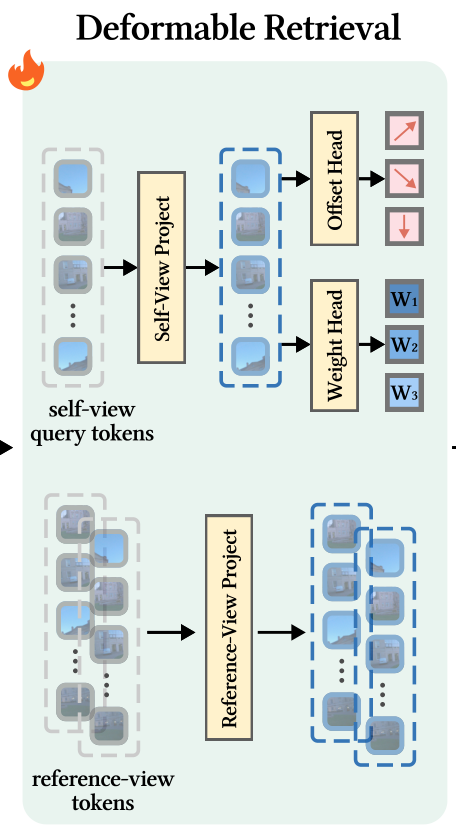
Project tokens into a compact latent space, predict a small set of bounded offsets and routing weights, and restrict reference views with a sliding window. This changes view interactions from all-pairs to a structured local search.
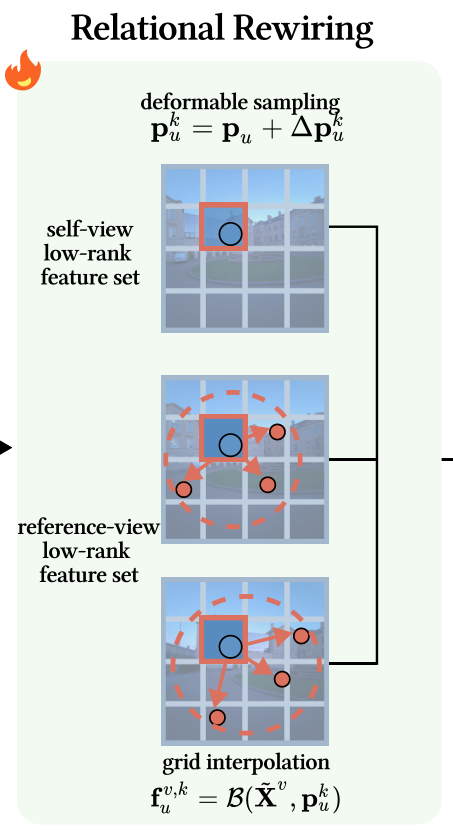
Use bilinear sampling at the predicted locations, then aggregate candidates with learned routing weights. The result is an explicit, sparse relational graph instead of unconstrained all-to-all attention.
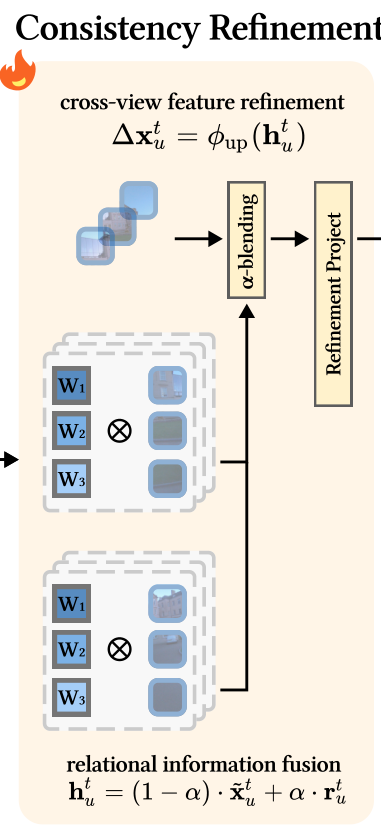
Fuse the self-view latent token with its rewired relation, project back to the backbone dimension, and apply a learned residual gate. The update improves consistency without overwriting the pre-trained representation.
Experiments
We evaluate low-light reconstruction on Oxford Day&Night, self-supervised test-time adaptation on 7-Scenes and NRGBD, and joint human-scene reconstruction on BEDLAM.
0.633
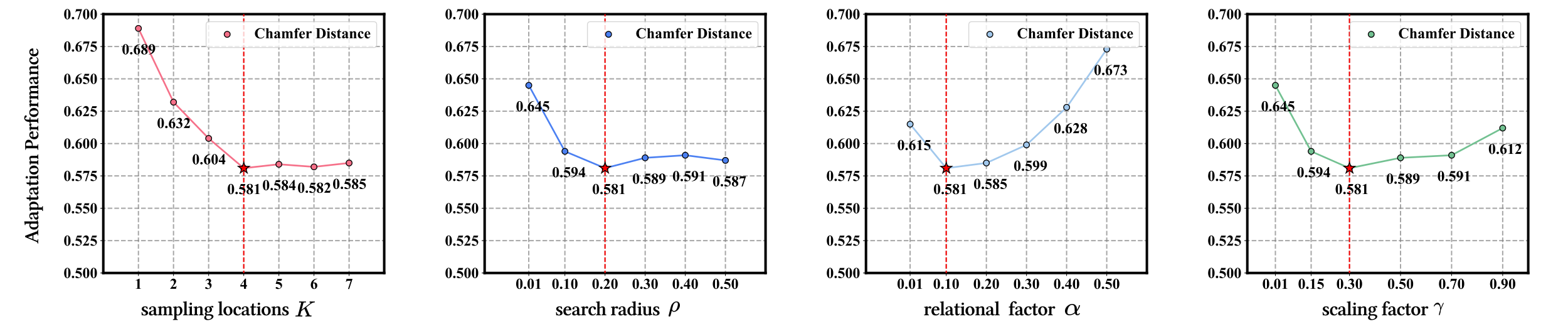
0.581
.216 / .205
44.4

Citation
@inproceedings{ai2026threeRAdapter,
  title     = {3R-Adapter: Retrieval, Rewiring, and Refinement
               for Efficient Adaptation of 3D Reconstruction Model},
  author    = {Ai, Zixiang and Cui, Zhenyu and Zou, Xu and Zhou, Jiahuan},
  booktitle = {Advances in Neural Information Processing Systems},
  year      = {2026}
}